
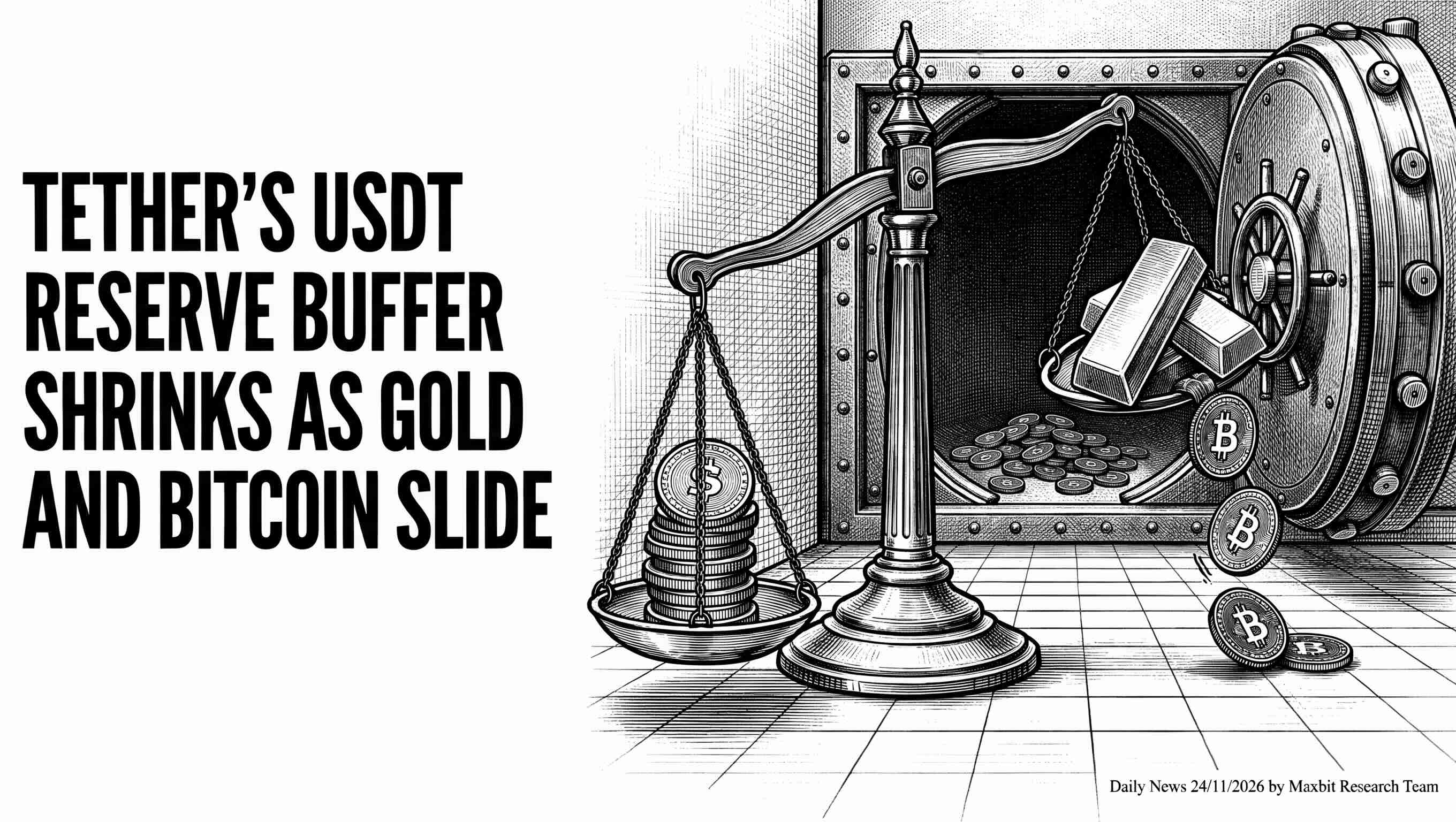
Tether, the issuer of USDT, the world's largest stablecoin, is facing fresh questions about the strength of its reserves. On 23 November 2026, South Korea's Seoul Economic Daily calculated that falling gold and bitcoin prices could shrink Tether's excess reserves by about 59%, from $7.95 billion to roughly $3.29 billion. The analysis lands in the same week that S&P Global Ratings kept USDT's stability score at 5 (Weak), the bottom of its scale, and as USDT in circulation fell by more than $8.8 billion in 60 days. The story matters directly to Thai crypto investors: USDT is the most heavily traded digital asset in Thailand and is widely used as a place to park funds during volatile markets.
The News: USDT's Reserve Buffer Could Shrink by Nearly 60%
According to Tether's Q3 2026 reserve report, published on 30 October 2026 and attested by accounting firm BDO, the company held $191.45 billion in assets at 30 September 2026 against $183.50 billion in liabilities (USDT issued). That left a surplus of $7.95 billion, a coverage ratio of about 104.3%, nearly double the $4.11 billion at the end of June, largely thanks to bitcoin's rally during the third quarter.
Those reserves, however, include $19.085 billion in gold (booked at $4,157 an ounce) and $8.367 billion in bitcoin (booked at $83,621). Seoul Economic Daily noted that on 23 November gold traded near $3,620 (down 12.9%) and bitcoin near $61,715 (down 26.2%). Marking both holdings to market would wipe out about $4.66 billion, leaving the surplus at roughly $3.29 billion. The Maxbit news team re-ran the calculation with the same inputs and reached a consistent result.
- An estimate, not an official figure: The calculation assumes Tether's gold and bitcoin holdings are unchanged and excludes fourth-quarter interest income. Tether reported operating profit of about $1.5 billion in Q3.
- Assets still exceed liabilities: Even after the estimated drop, reserves remain above the amount of USDT issued.
- Safe assets remain the core: The Q3 report shows about $132.4 billion in direct and indirect exposure to short-term US Treasury bills, with cash-like assets making up about 73% of reserves.
Key Figures
| Item | Figure | Note |
|---|---|---|
| Tether total reserves | $191.45B | As of 30 Sep 2026 (Q3 attestation by BDO) |
| Liabilities (USDT issued) | $183.50B | Coverage ratio about 104.3% |
| Excess reserves | $7.95B | Up from $4.11B at 30 Jun 2026 |
| Gold in reserves | $19.085B | Booked at $4,157/oz → $3,620 (23 Nov), down 12.9% |
| Bitcoin in reserves | $8.367B | Booked at $83,621 → $61,715 (23 Nov), down 26.2% |
| Excess reserves marked to market (estimate) | ≈ $3.29B | About 59% lower, per Seoul Economic Daily |
| Higher-risk assets vs. USDT in circulation | 28% | 24% a year earlier (S&P Global Ratings) |
| S&P stability score | 5 (Weak) | Lowest on a 1–5 scale, unchanged (assessed 18 Nov 2026) |
| USDT in circulation | ≈ $174.7B | Down $8.83B in 60 days (CryptoQuant) |
| Bitcoin price (context) | ≈ $61,200–61,700 | 23 Nov 2026; weekly low about $55,100 |
Background: S&P Keeps USDT at Its Lowest Score as Riskier Assets Rise to 28%
On 18 November 2026, S&P Global Ratings kept its Stablecoin Stability Assessment for USDT at 5 (Weak), the lowest level on its 1–5 scale, unchanged since its downgrade in November 2025. As reported by Bitcoin.com News and KuCoin, the main reason is that higher-risk assets such as gold, equities, corporate bonds and secured loans now equal about 28% of USDT in circulation, up from 24% a year earlier. S&P also cited limited disclosure about counterparties and whether reserves are segregated.
The score is not a credit rating; it measures how well a stablecoin can hold its dollar peg. S&P said the assessment could improve if Tether reduced volatile assets and published its full audited financial statements.
Reaction: Tether Says "The Problem Is S&P's Framework"
Tether pushed back, invoking the film The Big Short to question rating agencies' credibility. As cited by Cointelegraph, Tether said, "The problem is S&P's framework, not our reserves." When it released its Q3 results, CEO Paolo Ardoino said the company's responsibility is to keep USDT dependable when people need it most.
On the market side, CryptoBriefing, citing CryptoQuant data, reported that USDT in circulation fell by $8.83 billion in 60 days to about $174.7 billion, down from a May peak above $190 billion. Total stablecoin market cap stood at about $284.2 billion according to DefiLlama, down about 6% in 30 days. That points to money leaving the crypto market as bitcoin slid to about $55,100 on 21 November, its lowest since September 2024, before rebounding to around $61,000. The Fear & Greed Index sits at 11 (Extreme Fear).
What It Means for Thai Investors
Data from Thailand's Securities and Exchange Commission (SEC) show that in October 2026 USDT accounted for about 61% of digital asset trading value in Thailand. Many investors hold USDT as a parking spot between trades. This news is a reminder that stablecoins are not risk-free like bank deposits: their value depends on the quality of reserves and confidence in the issuer.
Meanwhile, the Thai SEC is consulting on draft rules for stablecoin transfers through licensed providers (a cap of 5 million baht per day and transfers only to the customer's own wallets) until 26 November 2026. We summarised the draft in Thai SEC Drafts Stablecoin and USDT Rules.
⚠️ Caution: The 59% drop in excess reserves is a media estimate based on market prices, not an official Tether report, and it does not mean USDT will lose its $1 peg. Check official sources and do not make investment decisions based on headlines alone.
Other Notable News Today
- Chainflip exploited for about $12 million: Cross-chain swap protocol Chainflip had its vaults drained on 21 November, losing about 122.86 BTC, 520 ETH and some stablecoins. The team put the protocol into safe mode and offered a 10% bounty for the return of funds. FLIP fell about 40%.
- Record outflow from IBIT: BlackRock's bitcoin ETF saw a record $541 million single-day outflow on 19 November. According to Zerocap, US spot bitcoin ETF outflows for November total about $3.6 billion.
- Hong Kong advances licensing rules: According to KuCoin, Hong Kong gazetted draft licensing rules for virtual asset service providers, while the European Central Bank launched its Appia initiative for tokenised deposits and securities.
What Should Investors Do?
- Understand how stablecoins work before holding them. Start with What Is USDT and How Do Stablecoins Work.
- Don't hold more USDT than you need. Use it as short-term parking and diversify according to your goals, for example with a bitcoin DCA strategy.
- Use a legitimate platform supervised by the Thai SEC.
- Watch the next quarterly reserve report and Thai SEC announcements rather than social-media rumours.
Frequently Asked Questions (FAQ)
Is USDT still holding its $1 peg?
As of 19–23 November 2026, USDT was still trading close to $1 (around $0.999), and according to its latest report Tether still holds more assets than liabilities, even if its excess reserves may have shrunk as gold and bitcoin fell. Investors should watch the next quarterly reserve report and regulatory announcements.
Does S&P's score of 5 (Weak) mean USDT will collapse?
Not directly. S&P's score assesses a stablecoin's ability to maintain its dollar peg; it is not a credit rating. A score of 5 reflects a high share of riskier assets in reserves and limited disclosure. It is a risk worth understanding and diversifying against.
What should Thai investors holding USDT do?
There is no need to panic, but investors should review how much of their portfolio sits in stablecoins, avoid concentrating in a single coin more than necessary, trade through providers supervised by the Thai SEC, and follow the SEC's draft stablecoin transfer rules, which are open for public comment until 26 November 2026.
Invest in digital assets with confidence on a platform supervised by the Thai SEC — sign up for Maxbit today.
Risk warning: Cryptocurrencies and digital tokens carry very high risk, and you may lose your entire investment. Please study and understand the risks before investing. This article is for informational purposes only and is not trading advice.