

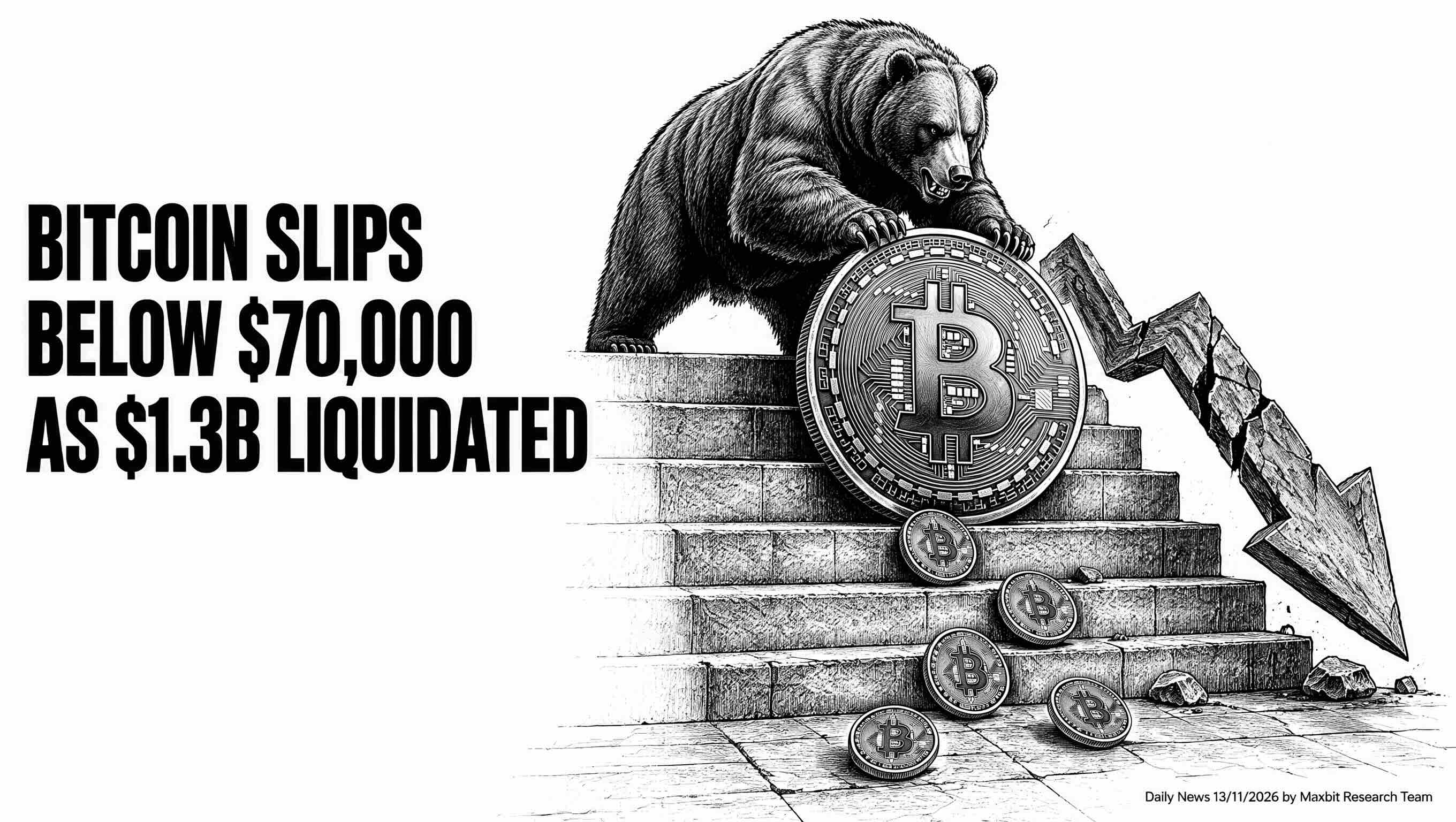
Bitcoin (BTC) slipped below $70,000 early on Friday, 13 November 2026 (Asian hours), touching an intraday low near $69,000, its lowest level since mid-August, after falling roughly 4–5% in 24 hours. The selloff forced the liquidation of more than $1.3 billion in futures positions across the crypto market, while Ether (ETH) dropped below $2,000 for the first time in about three months. Here is what happened, what is weighing on digital assets, the support and resistance levels traders are watching, and how medium- to long-term investors can plan.
Bitcoin Falls Below $70,000: Key Numbers
Weakness began on Thursday, 12 November, when BTC lost $72,000 and broke below its 200-day moving average around $73,100–73,200, before selling accelerated during Friday's Asian session.
| Metric | Latest data |
|---|---|
| BTC intraday low | About $69,000 — lowest since August 2026 |
| 24-hour change | Roughly -4% to -5% |
| Market-wide liquidations (24h) | Over $1.3 billion (BTC about $677 million) |
| Largest single liquidation | A BTC long worth over $31 million |
| US spot Bitcoin ETFs | Five straight days of net outflows, about $1.44 billion |
| ETH | Below $2,000 for the first time since August |
| Crypto Fear & Greed Index | 28 ("Fear") |
| Distance from all-time high | About -45% (ATH ~$126,000, Oct 2025) |
4 Factors Pressuring the Bitcoin Price
1. Hotter US inflation raises Fed rate-hike fears
US October CPI rose 0.4% month on month (0.3% expected) and core CPI rose 0.3% (0.2% expected), pushing markets to price a higher chance of a Fed rate hike at the 9 December meeting. The Dollar Index (DXY) climbed above 103, its highest since April 2025, a headwind for risk assets such as crypto.
2. Institutional money is leaving Bitcoin ETFs
US spot Bitcoin ETFs posted five consecutive trading days of net outflows totalling about $1.44 billion. On 11 November alone, outflows were about $300 million, including about $270 million from BlackRock's IBIT, a sign that institutional demand, a key driver of earlier rallies, has yet to return.
3. Tech-stock turmoil and Strategy index news
According to international media reports, Nvidia shares tumbled intraday on news of its CEO's departure, dragging chip stocks and broader risk appetite. Separately, MSCI said it will remove Strategy, the largest corporate holder of BTC, from its main indices effective 30 November. Strategy is not selling bitcoin, but the news weighed on sentiment indirectly.
4. Middle East tensions
Media reported that Iran's IRGC claimed to have destroyed a US early-warning radar in Bahrain, prompting investors to cut risk, while WTI crude hovered near $88–89 a barrel.
⚠️ Leverage amplifies losses: more than 85% of positions wiped out in this move were leveraged longs. When price breaks key support, forced selling cascades and pushes prices down faster than fundamentals alone would. Beginners should avoid leverage in volatile markets.
Support and Resistance Levels to Watch
- Resistance: $72,000–74,000 and the 200-day average near $73,100. Reclaiming this zone would ease short-term pressure.
- First support: around $68,000, based on CoinGlass's liquidation heatmap.
- Next support: $65,000, then the $62,800–64,000 zone if selling continues.
Some analysts note BTC could close a sixth consecutive losing week, and the overall crypto market has shed about $550 billion in value since early October.
What Should Investors Do When Bitcoin Falls?
- Don't panic-sell. Check whether your original reason for investing still holds.
- Accumulate gradually with DCA instead of investing a lump sum. Read more: Bitcoin DCA strategy
- Use stop-losses and cap your crypto allocation at a level you can tolerate. See how to set stop-loss and take-profit
- Consider parking funds in USDT while you wait. See What is USDT?
- Watch the calendar: Nvidia earnings (17 Nov), MSCI index change (30 Nov), Fed meeting (9 Dec).
Frequently Asked Questions (FAQ)
Why is Bitcoin falling today?
Mainly hotter-than-expected US inflation that raised Fed rate-hike fears, continued Bitcoin ETF outflows, tech-stock volatility and Middle East tensions, compounded by more than $1.3 billion in leveraged liquidations.
Will Bitcoin keep falling?
No one can predict this with certainty. Markets are watching support at $68,000 and $65,000; a move back above $72,000–74,000 would signal that selling pressure is easing.
Is now a good time to buy Bitcoin?
It depends on your goals and risk tolerance. For long-term investors, buying gradually with DCA using spare money can reduce the risk of poor timing.
Track prices and start investing in Bitcoin with a plan on a platform regulated by the Thai SEC — open your Maxbit account
Risk warning: Cryptocurrencies and digital tokens are highly risky and volatile. You may lose your entire investment. Please study and understand the risks before deciding to invest. This article is for information only and is not investment advice.