
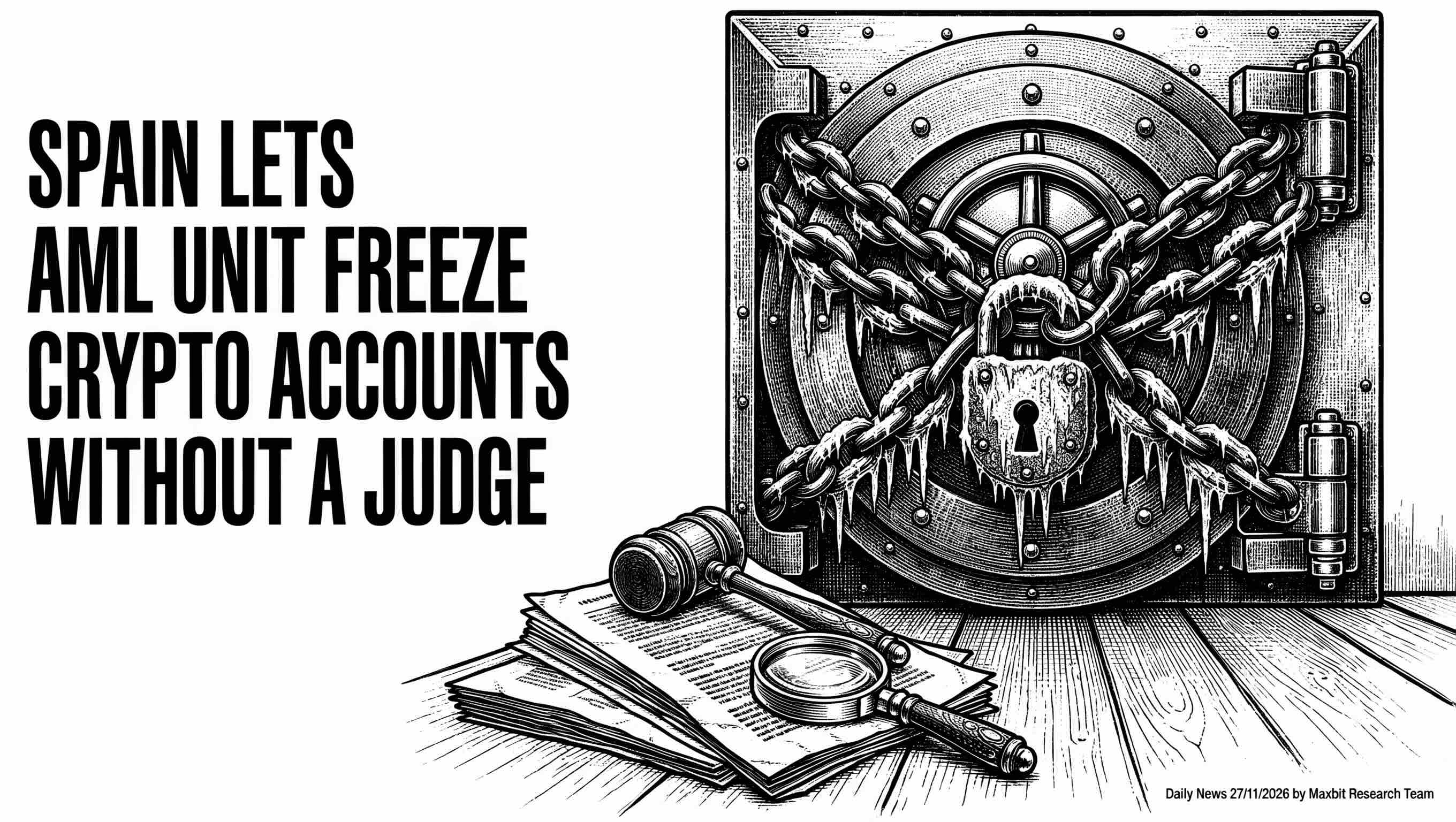
Spain has given Sepblac, its anti-money-laundering financial intelligence unit, the power to freeze crypto accounts and other financial accounts temporarily without a court order, under a royal decree-law published in the Official State Gazette (BOE) on November 25, 2026. Sepblac can suspend accounts for up to 5 business days and transactions for up to 10 business days when there are signs of money laundering or terrorist financing. The rule takes effect on January 25, 2027.
The move matters because Spain is one of the European Union's larger digital asset markets, and it is a clear sign that regulators worldwide are moving toward a "freeze first, court later" approach for crypto funds that can move in minutes. This article explains what the new rule allows, why Spain adopted it, how the market is reacting and what Thai investors should take from it.
How Spain's Sepblac Can Now Freeze Crypto Accounts
According to CoinDesk, Decrypt, Cointelegraph and Finance Magnates, the powers were included in a decree on consumer credit that adds a new provision to Spain's anti-money-laundering law. The key points:
- Accounts or business relationships can be suspended for up to 5 business days, and transactions for up to 10 business days, where there is reasonable suspicion of money laundering or terrorist financing.
- Once the deadline passes, the order lapses unless a prosecutor applies and a judge extends it.
- According to Decrypt and Finance Magnates, the scope covers bank, payment and crypto-asset accounts.
- Failure to comply with an order is classed as a "very serious infringement," while firms that comply in good faith are shielded from liability.
What Changed
Previously, Sepblac could only act at the request of a foreign financial intelligence unit. Under the new rule it can act on its own analysis or at the request of Spanish police and EU or third-country FIUs. According to Decrypt, when a case starts from a bank's or provider's suspicious activity report, Sepblac must issue its order within 3 business days.
Key Figures
| Item | Details |
|---|---|
| Legal instrument | Royal Decree-Law (Finance Magnates reports it as No. 44/2026), published in Spain's Official State Gazette (BOE) on Nov 25, 2026 |
| Account / business-relationship freeze | Up to 5 business days |
| Transaction freeze | Up to 10 business days |
| Extension | Requires a court order at a prosecutor's request |
| Effective date | Jan 25, 2027 (Congress must validate within 30 days) |
| Suspicious activity reports from crypto providers in Spain | 1,672 in 2025 vs. 972 in 2024 (per Decrypt, citing Sepblac's annual report) |
| FATF evaluation | On-site visit Feb 2027 / plenary discussion Oct 2027 (per Decrypt) |
| Market context: Bitcoin | Back above $60,000 on Nov 26, 2026 (Bloomberg) |
Background: FATF Pressure and the Speed of Digital Money
The Spanish government says the change aligns the law with standards of the Financial Action Task Force (FATF), which is evaluating Spain again, and describes the old limitation as a gap. Decrypt also reports that the rule partly transposes the EU's sixth anti-money-laundering directive, and the government argues that digital transfers move so fast that funds could be gone before a court acts.
Sepblac annual report figures cited by Decrypt show suspicious activity reports from crypto providers nearly doubled in a single year, underlining how much more attention crypto is receiving in Spain's AML work.
Reactions
Nikolai Timofejev, head of licensing and regulatory affairs at consultancy Prifinance, told Cointelegraph he supports the measure and would like to see similar rules across the EU. He advised crypto providers to appoint a named person to receive Sepblac's orders given the tight deadlines, and said fines for non-compliance start at €150,000 (a consultant's view; no other source has confirmed that figure from the decree text).
On the other side, Finance Magnates' headline, "Freeze First, Court Later," captures concerns about account holders' rights: honest users could see accounts frozen temporarily before any judicial review, even though the law caps the freeze at 5–10 business days.
What It Means for Thai Investors
Spain's rule does not apply to accounts in Thailand, but it points in the same direction Thailand is already heading. Thailand's amended Emergency Decree on Measures for the Prevention and Suppression of Technology Crimes, in force since April 13, 2025, extended mule-account and suspicious-transaction measures to digital asset businesses, and the Thai SEC has stepped up blocking of unlicensed platforms.
The lesson for investors is that account transparency will matter more and more. Using a platform regulated by the Thai SEC, completing KYC fully and keeping records of where your money comes from reduce the chance of an unnecessary prolonged freeze and help resolve any review quickly. Using foreign platforms that are not licensed in Thailand carries both legal and investor-protection risks.
⚠️ Caution: Never lend or rent out your crypto trading account, and never accept money or USDT transfers from strangers. Your account could be used as a "mule account," leading to a freeze or even prosecution.
Other Notable News Today
- Record outflows from US Bitcoin ETFs — November net outflows reached $5.39 billion (data through Nov 25), breaking June's previous record of $4.51 billion.
- Switzerland's retail spot Bitcoin ETF starts trading — According to The Block, BIT Asset Management's BBIT began trading in Switzerland following FINMA approval.
- MSCI to drop Strategy on Nov 30 — According to Coin Edition, the largest corporate Bitcoin holder will be removed at the Nov 30 close, with rebalanced indexes effective Dec 1, 2026.
What Should Investors Do?
- Complete identity verification and keep your account details up to date. Read more: What Is KYC? A Guide to Identity Verification Before Trading
- Learn to spot scams and mule-account schemes: Common Crypto Scams and How to Avoid Them
- Keep your own assets secure: What Is a Crypto Wallet? Hot Wallet vs. Cold Wallet
- Trade only on platforms regulated by the Thai SEC, which must meet custody and security standards.
Frequently Asked Questions (FAQ)
What is Sepblac?
Sepblac is Spain's financial intelligence unit (FIU), comparable to Thailand's Anti-Money Laundering Office (AMLO). It receives suspicious transaction reports from banks and crypto service providers, analyzes them and passes cases to law enforcement to fight money laundering and terrorist financing.
Does Spain's new rule affect crypto investors in Thailand?
Not directly, since it applies to providers and accounts under Spanish law. But it reflects a global trend of giving authorities faster powers to freeze crypto accounts on money-laundering suspicion. Thailand already has measures to suspend mule accounts and suspicious transactions that cover digital asset businesses.
What should I do if my crypto account is temporarily frozen?
Contact the platform's customer support through official channels only, prepare your identity documents and proof of source of funds, and beware of scammers offering to "unlock" accounts for a fee or asking for passwords. Platforms regulated by the Thai SEC must have clear procedures for handling complaints and informing customers of their rights.
Invest in Bitcoin, USDT and other digital assets with confidence on a platform regulated by the Thai SEC — Sign up for Maxbit today
Risk warning: Digital assets are high risk and highly volatile. Investors may lose their entire investment. Study the information and understand the risks before investing. This article is for informational purposes only and is not investment advice.