

Weekly Research Recap 06 - 13 July 2026
For the week of 06 - 13 July, 2026
.png)
Weekly Recap Research
Crypto hacked a maximum of 207 times, but first-half damage dropped to $972 million

The crypto industry faced 207 hacking incidents in the first half of 2026, the highest number ever recorded. However, the total damage value is around $972 million, below $1 billion, and less than half of the damage in the same period of 2025. The figures reflect that even as the frequency of attacks increases, the average damage per event is falling, especially in The DeFi sector where the value of vulnerability damage has fallen by 74 percent, from a peak of $2.62 billion in 2022 to $680.3 million.
Market risks are shifting from vulnerabilities in Smart Contracts to more infrastructure-level problems, whether it's private key leaks, faulty cross-chain system settings, or high-powered system access rights management. Meanwhile, Immunefi has paid a total of about $13.45 million to researchers who discovered more than 837 verified vulnerabilities before the niche. Those vulnerabilities will be deployed to attack. The platform currently has more than 92,000 researchers, helping to oversee over $180 billion in assets, covering more than 650 protocols, so the overall picture reflects how the industry can cope with the attack. More efficiency, even if the number of incidents is at a record high, and it also underlines that safety will remain an important factor that cannot be overlooked by any project.
Bitcoin stuck around $60,000 to $70,000 for 307 days, accumulating strength ahead of big direction pick

Bitcoin has continued to move in the $60,000 to $70,000 range for 307 days, making it the third longest trading range in the $10,000 price frame in history, behind the $10,000 to $20,000 and $20,000 to $30,000 frames. Even though the current price is near the $64,000 level, it is about 50% below the all-time highs made in October, reflecting that the market is still in range. Accumulate strength and wait for new factors to enter, determine the direction in the next phase.
On-chain data indicates that about 6% of the circulating supply, Bitcoin has an average cost of between $58,000 and $64,000, making the area a key support as many holders have an incentive to hedge their own costs. Meanwhile, the price can also stand above the 200-week average line at around $62,873, a level that investors use to track long-term trends if Bitcoin follows a long-term trend. The area can be maintained. Opportunities for a return to test the $70,000 level remain open, but if it breaks below $58,000, the selling force from holders who are beginning to go into a loss could add to the pressure and accelerate the market into a deep adjustment. upgradable
Top Net flows
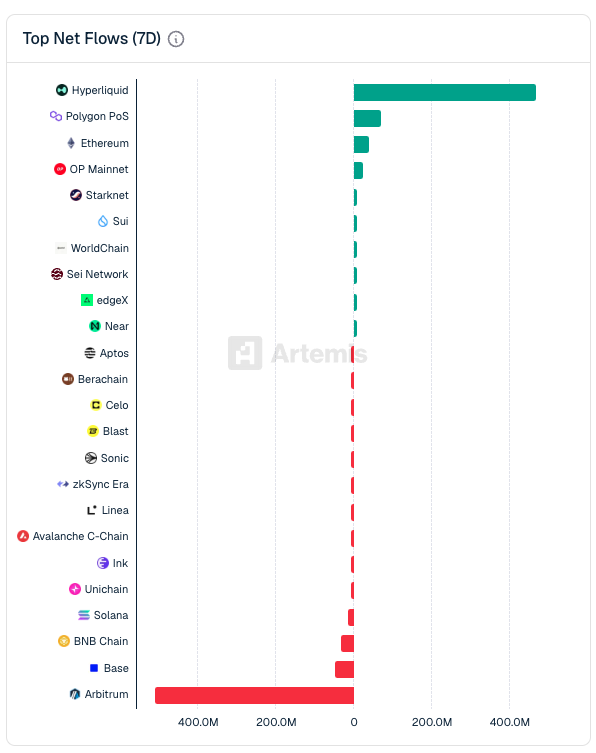
Seven-day net cash flow data between July 6—12, 2026, indicated that Hyperliquid had the highest inflows in the market at around $470 million, followed by Polygon PoS at around $70 million, Ethereum at around $35 million, and OP Mainnet near $20 million. Such cash flows are consistent with the growing popularity of onchain derivatives markets and the expansion of assets outside the crypto market. Grows on Hyperliquid, meanwhile, Hyperliquid Policy Center and Phantom filed a proposal with the CFTC on July 9, disagreeing with the direct adoption of regulations for traditional brokers to the Onchain protocol, reflecting that. That the growth of the platform is pushing for regulatory issues to become even more important.
On the other hand, Arbitrum has about $500 million in cash outflows, the most in the network, followed by Base at around $50 million and BNB Chain around $35 million. Even as the overall crypto market rebounded on July 10, with Bitcoin rising close to $64,000 and up 4.2 percent in seven days, while Ether moved up to around $1,790. But the flow of capital has not been evenly distributed back into all networks. The overall picture thus reflects that investors are choosing platforms that can clearly generate trading volume and income, rather than distributing their investments based on the overall market recovery.
Fear & Greed Index
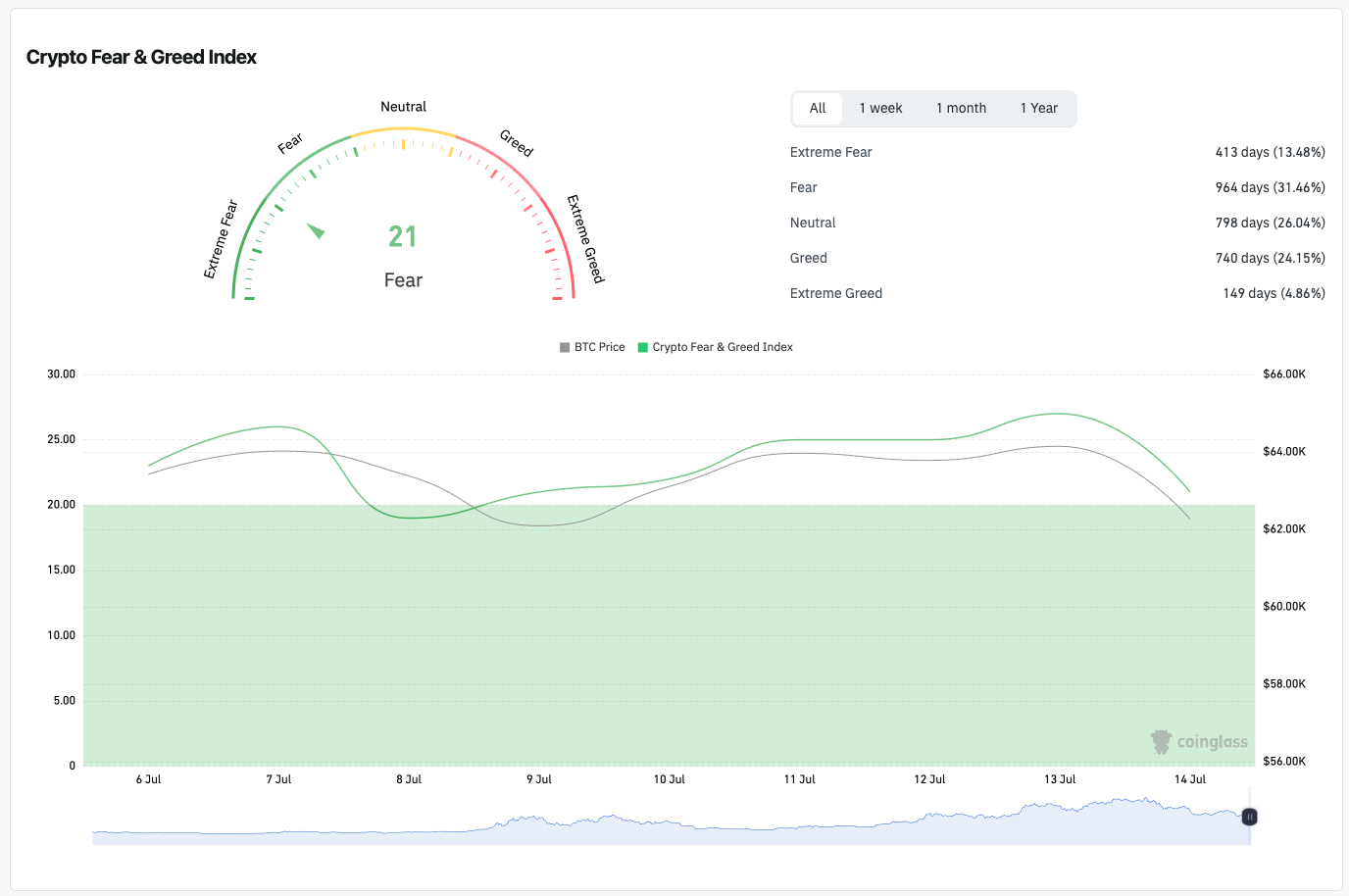
The Crypto Fear & Greed Index is one of the tools used to assess the outlook and sentiment of the crypto market, referring to scores ranging from 0 to 100 (0 stands for Extreme Fear or Extreme Fear and 100 stands for Extreme Greed).
The Crypto Fear and Greed Index started the week on July 6, 2026 at around 23 points, before climbing to 26 points on July 7, after Bitcoin recovered to trade around $62,800 from below $58,000 earlier in the month. However, sentiment weakened again to around 19 points on July 8, amid pressure from Strategy's Bitcoin sell-off. The total amount of 3,588 BTC is worth about $216 million, prompting the market to worry that major holders may need to sell the asset to maintain liquidity, even though the company still holds a total of 843,775 BTC in Bitcoin.
The investment climate began to recover late in the week, with Bitcoin climbing from around $61,850 to near $64,000 on July 10, rising about 3.5 percent in a single day and delivering a seven-day return of about 4.2 percent, while the Sentiment Index rebounded near 25 points on July 11—12. The recovery was supported by a weakening US dollar, a strengthening yen and a rise in Asian semiconductor stocks. However, the index remained in the fear zone, reflecting that investors had begun to ease concerns but were not fully exposed to risk. Until the price of Bitcoin is able to stand steadily above the $64,000 level.
Bitcoin ETF Flow
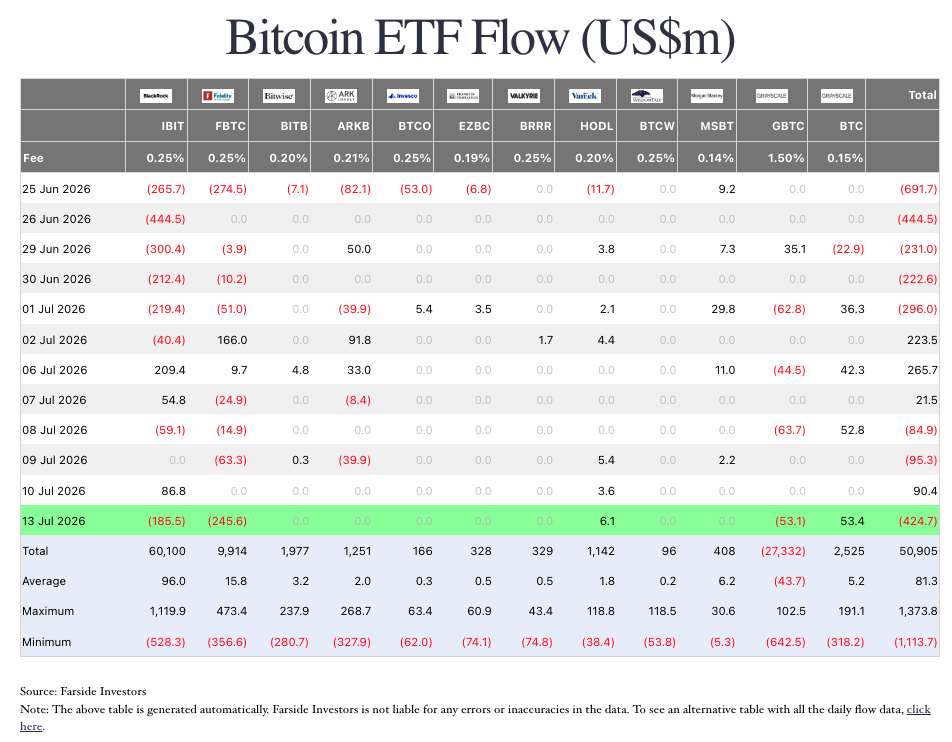
The U.S. Spot Bitcoin ETF had a total net inflow of $197.4 million between July 6—10, 2026, opening the week with $265.7 million in net inflows, followed by another $21.5 million, then reversing direction to $84.9 million and $95.3 million in outflows on July 8 and 9, respectively, Blacks' IBIT side. Rock had accumulated net inflows of $291.9 million, the highest in the group, while Grayscale's GBTC and Fidelity's FBTC had net outflows of $108.2 million and $93.4 million, respectively, reflecting that institutional investors have not yet fully returned to the market simultaneously, but have the characteristics of Transferring funds between funds rather than buying the entire market on a broad scale
The buying momentum early in the week came despite Strategy announcing the sale of 3,588 BTC worth about $216 million on July 6, causing the price to temporarily drop to the $61,900 area before rebounding above $63,000 again, while on July 10, Bitcoin rose above $64,000 and gave weekly returns. At 4.2 percent, with ETF inflows returning to $90.4 million in net inflows, the overall picture reflects that buying power from institutional investors is starting to return, even as midweek outflows suggest market sentiment remains fragile and recovery direction continues. Continuous inflows must be relied on to confirm the trend in the next phase.
Ethereum ETF Flow
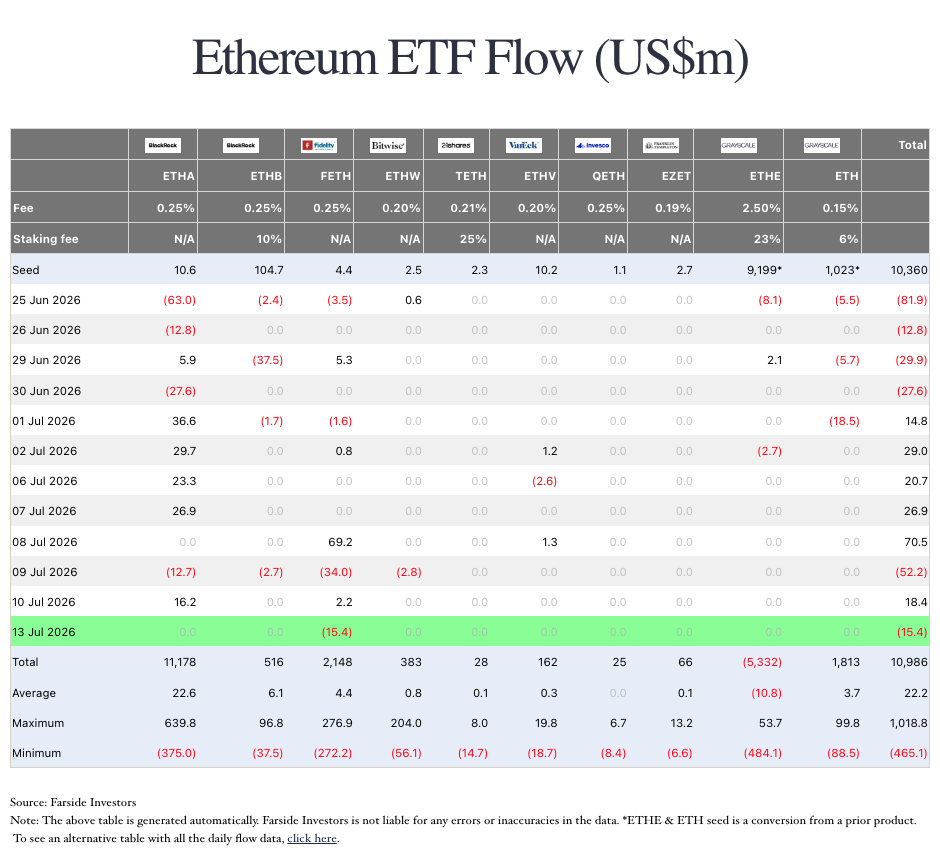
The US Spot Ethereum ETF had a total net inflow of approximately $84.3 million between July 6—10, 2026, marking the first week that capital flows returned positive since May 8, after facing 8 weeks of continuous outflows totaling about $1.20 billion, with inflows of 4 out of 5 business days throughout the week, while July 8 was most notable, with net inflows of around $70.5 million, led by Fidelity's FETH of $69.2 million. BlackRock's ETHA segment had accumulated net inflows of about $53.7 million throughout the week.
However, on July 9, there was still a net outflow of $52.2 million, before the cash flow returned to positive again on July 10, with net inflows of $18.4 million, reflecting that institutional investor sentiment began to recover but continued to move in line with short-term market conditions. The same period, Ether recovered from the 1,area. The $770 rose close to $1,810. Even though the inflows this round offset only about 7 percent of the capital outflows over the previous eight weeks, the overall picture reflects that the selling force is beginning to slow and the market is signaling a recovery in capital flows, despite tracking the continued inflows in the period. Next, to clearly confirm the return of purchasing power from institutional investors.
Important news:
Source:
Note: This analysis is provided every Monday, so some articles may have data discrepancies.
Nota: Questo analisi è situato ogni monday, quindi alcuni parti del articolo possono contengono informazioni inaccurati
WARNING: CRYPTOCURRENCIES AND DIGITAL TOKENS ARE HIGHLY RISKY. YOU MAY LOSE YOUR ENTIRE INVESTMENT. PLEASE STUDY AND INVEST ACCORDING TO THE ACCEPTABLE LEVEL OF RISK.
Thank you for following.
J.P. Daniel
News Cryptocurrency



News Cryptocurrency
Download the application Maxbit is available at


Securely register with a digital asset trading platform regulated by Thailand’s SEC.



MAXBIT DIGITAL ASSET CO., LTD. 90 CW Tower, Floor 31
Room A 3101-02, Ratchadaphisek Rd,
Huai Khwang, Bangkok 10310
Follow Us:


